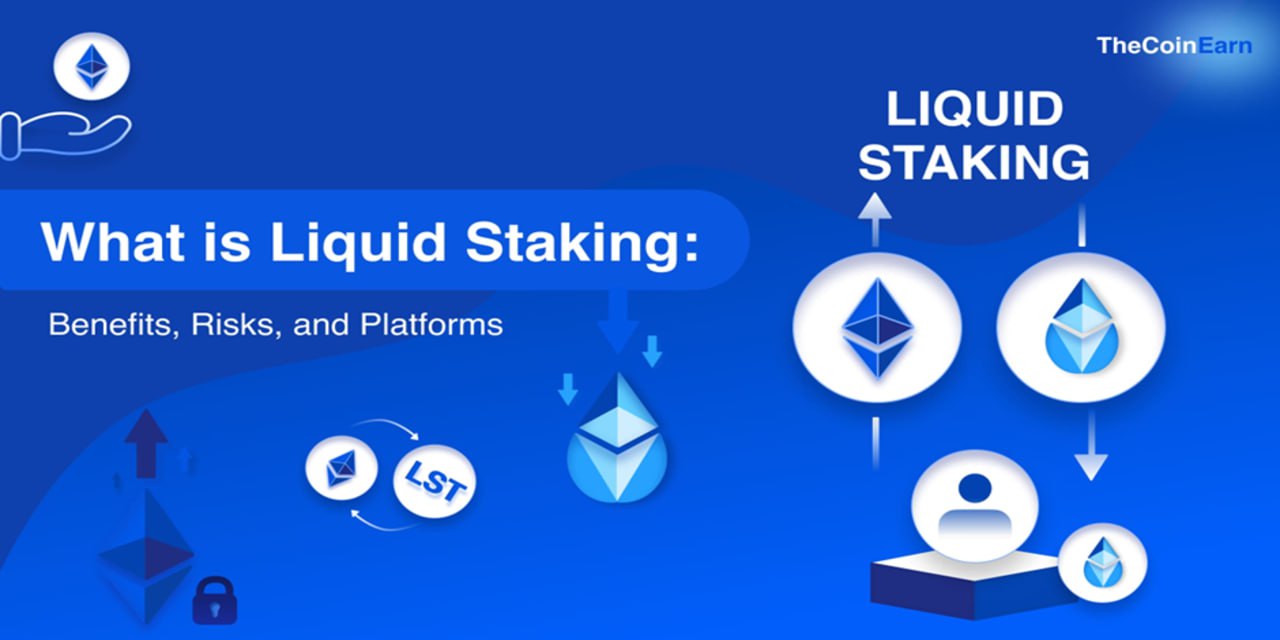
The rapid expansion of liquid staking is reshaping the foundation of crypto market infrastructure, enabling investors to earn staking rewards without surrendering liquidity — a development analysts say is “as significant as the rise of stablecoins” for the next phase of digital-asset innovation.
According to data from DeFi analytics platforms, global liquid staking deposits have surged past $4.5 billion, driven by long-term Bitcoin and Ethereum holders seeking predictable, compounding growth during a prolonged market cooldown. The model is increasingly viewed not as a niche DeFi tool, but as a structural upgrade to how value is stored, utilized, and multiplied on-chain.


A Structural Evolution: Staking, Without the Lockup
Traditional staking models on centralized exchanges typically require 21–30 days of unbonding, forcing investors to immobilize their capital and absorb market volatility without the ability to adjust positions.
Liquid staking redefines that framework by issuing transferable derivative assets — stETH, stBTC, or protocol-specific LSTs — that remain fully liquid. These assets continue earning network-level staking rewards while functioning as freely deployable instruments across lending markets, liquidity pools, and trading venues.
For investors, this creates a two-layer benefit:
Continuous reward accumulation, generally in the 3–7% APY range. Unrestricted liquidity, with redemptions available within 72 hours in most protocol designs. “Liquid staking takes what used to be dormant yield and turns it into active capital,” said Evan Rhodes, senior analyst at Arcturus Digital.
“It introduces a liquidity profile that aligns with both institutional mandates and long-term wealth-building strategies.”
Why Long-Term Investors Are Turning to Liquid Staking
With markets drifting sideways for nearly a year, an increasing number of long-term investors are shifting from passive holding to strategies that increase asset count independent of price action.
“With Bitcoin and Ethereum moving in narrow ranges, long-term holders are looking for mechanisms that increase their stack without deploying additional capital,” said Rhodes.
“In that sense, liquid staking has become a structural accumulator rather than a short-term yield product.”
Because liquid staking rewards compound over time, many analysts compare the strategy to on-chain dividend reinvestment, where investors steadily expand their token base while waiting for the next market cycle.
This accumulation effect becomes especially powerful once markets recover: a higher token count generates amplified upside without higher risk exposure.
Institutional Interest Intensifies
Liquid staking is also emerging as a preferred tool for institutions executing hedged, delta-neutral, or market-making strategies.
Historically, funds avoided staking due to inflexible lockups that restricted their ability to rebalance portfolios.
Liquid staking eliminates that constraint.
“Liquidity is the dividing line for institutional adoption,” said Maya Levin, head of research at VentureFlow Capital.
“The moment staking became liquid, it moved from an optional yield enhancement to a core allocation tool.”
In particular, Bitcoin-focused liquid staking protocols — a category that barely existed two years ago — are seeing rapid inflows as ETFs normalize BTC custody across the U.S. wealth-management ecosystem.